Tag Archives: fuel pump

bowtie6‘s Custom Wiring – Trunk

The last post talked about the harness and fuse box under the hood.  Today’s post shows the wiring in the trunk.

Since we are far from “original”, I wired up bowtie6 in a practical way.  There is a fusebox in the engine compartment (as discussed previously), one in the cab compartment (to be discussed) and one in the trunk (discussed here). Why go through all this trouble?

Well, for starters I wanted to keep things simple.  But mainly because there was not enough room underneath the hood!  Besides, it makes sense to control things where they belong and in the trunk there are several things to control…

Battery

The Optima Red-Top dry cell battery in bowtie6 is mounted in an aluminium enclosure pictured above.  The B+ terminal has a welding machine cable attached to it and it runs inside the TR6′s cab and ties into the firewall post.  The ground terminal is also a welding machine cable going through the body and securely bolted to the frame.  In the engine compartment, there are two more welding machine cables grounding the body and the engine to the frame. Finally, there is a B+ lead from the battery to two circuit breakers mounted in a special mount that control the following:

  1. Fuel Pump
  2. Backup Lights
  3. Brake Lights

Fuel Pump

The ECOTEC needs a high pressure fuel supply.  This comes from a GM high pressure pump as fitted to late-model Corvettes.  We used that pump because it is very small, has a filter “sock” and can be mounted in a small enclosure.  In the picture above you can see the fuel pump enclosure – that is the aluminium box resting on the trunk’s floor.  I’ve written about this before but basically that is an external tank plumbed to the main custom made all aluminium fuel tank.  We have about a 300 mile range in city driving with this setup.  I am sure it will be more once we do a long, highway trip.

The picture above shows two circuit breakers and three relays.  The fuel pump has one of the relays and one of the circuit breakers.  The control side of the relay is fed from a signal from the ECM.  When done right, the ECM sends a 5 second signal and energizes the pump.  This primes the fuel rail and gets things ready for ignition.  Once the engine fires, the ECM re-energizes the relay and that keeps the pump running until the ignition switch is turned off.

Backup Lights

The AISIN 5 speed gearbox has a built in switch that makes ground when the stick engages reverse.  I took advantage of this to make the TR6′s backup lights work.  Basically since this is a switch and it makes ground, I wired this into the control circuit of a relay.  This minimizes wear on the switch and voilà, we have backup lights.

Brake Lights

Ah!  Brake lights!! As you had guessed, I used a relay to run the brake lights.  As with the fuel pump and backup lights there is a hard voltage circuit from B+ on the battery to the relay.  This is controlled by breaking ground on the brake pedal switch.  Simple.  Brakes work flawlessly and will be there forever – the brake switch breaks ground.

 In Summary

Once again, I realize this is borderline overkill.  However, this makes things very simple and easy to fix if need be.  Setting this back circuitry together took little time and works like a charm.  As with the engine compartment fuse box, I added red “booties” to the circuit breakers.  You can also see the trunk floor is fully covered in black carpet now.

Here is a closeup of the rear wiring:

If you look close enough you will see several things here…

  • The lid to the battery box.  The box is made from aluminium and bolted securely to the side floor of the trunk.  This is mounted on the passenger’s side to even out weight distribution.  As mentioned previously, the battery is a dry cell Red Top Optima battery.  They are very durable and although they are expensive, they are very worth the cost.
  • The black plastic background.  That is ABS material pre-bent and cut to fit the sides of the trunk.  There is one on all sides, including the inside back of the trunk.  I used this because it is very easy to work with and can be shaped with simple tools such as scissors and a break.  This stuff is also very durable and looks very clean.  Much superior to the crappy cardboard “trunk liner” kits sold by the Big Three vendors.
  • The aluminium plate holds three relays and two circuit breakers.  I’ve discussed these above.
  • Finally, if you really look close you can see two rubber hoses right behind the circuit breakers.  What is this all about?  Well, my bowtie6 is from the very fine 1972 vintage.  In 1972 a special “tank” was affixed to the inside of the passenger’s side trunk.  This tank had two lines attached to it.  The first line came from a vent on the fuel filler neck.  The other line was routed to the intake.  This ensured all fuel tank fumes get routed back to the engine.  This has been retained and is fully operational in bowtie6.

Attention to detail?  Hell yes.

There are so many small details on bowtie6 that get overlooked!  However, I know they are there and this makes the difference.  With this TR6, there is not only killer looks in the form of a very shiny paint job, a powerful engine and a great handling frame but there are also countless details that separate this from even “restored” examples…


VN:F [1.9.22_1171]
Rating: 0.0/10 (0 votes cast)
VN:F [1.9.22_1171]
Rating: 0 (from 0 votes)

Ecotec Fuel System – Part 2

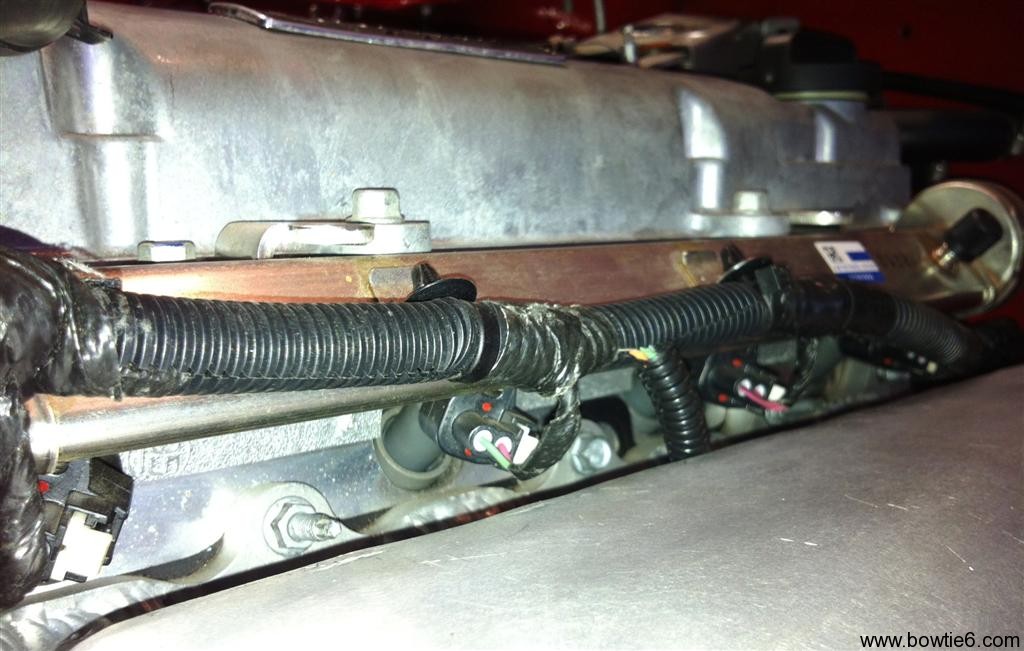
Just a followup on yesterday’s post.  This time, a few pictures of the engine side of things.  Here is the fuel rail, on the extreme right is the fuel inlet and below the rail itself is the loom holding the wires for the injectors.

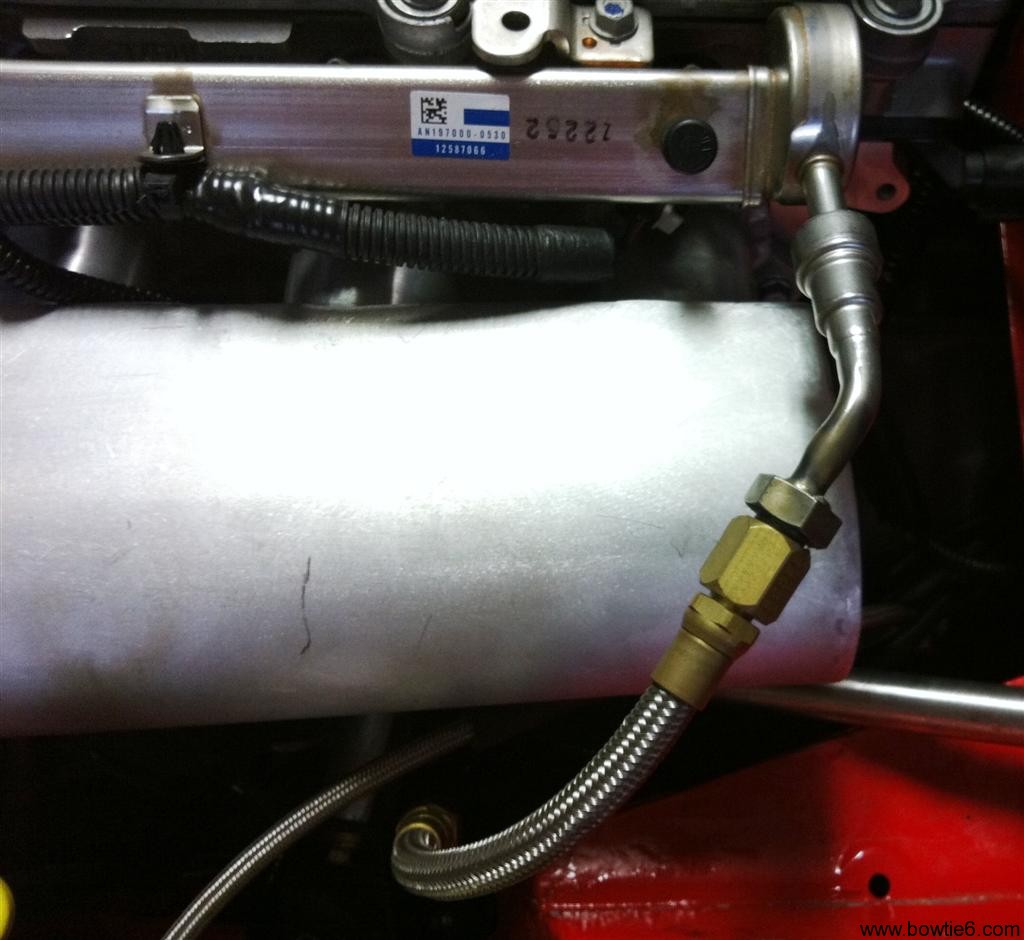
Here is the fuel supply side.  This one took some doing.  At the extreme lower side (close to the car’s body) you can see the end of the braided line.  That end has a crimped fitting that screws into the stainless steel line feeding fuel from the rear of the car.  That stainless line is held in place by these really cool brackets that unfortunately are not seen.  I’ll have to post about them in a later installment.  At any rate, on the other side of the braided line is another fitting that screws into the solid line shown below.

That line is basically a factory unit that has been modified bigtime.  Ther is a threaded fitting that was silver soldered that allows the braided line to be screwed on.  The reason why this had to start as a factory item is because of the special connector on the side of the fuel rail.  That one clicks into the tube sticking out of the fuel rail.  There is a special took that is used to take that out, by the way.

Finally, on the fuel rail itself you can see the Schrader valve (that black dot) on the right.  This is where you can tap a fuel pressure gauge into, for measuring fuel pressure.  This is all factory items.

Finally, this is what the injector underneath the fuel rail looks like. The rail looks rusted but that is only reflection from the red paint from the rest of the car.  In reality it is quite shiny.  This is number 2 injector going into the head.

And this keeps the engine alive and kicking!

VN:F [1.9.22_1171]
Rating: 10.0/10 (1 vote cast)
VN:F [1.9.22_1171]
Rating: 0 (from 0 votes)

Ecotec Fuel System

Supplying fuel to the Ecotec required a special delivery system.  Unlike the system we had in place for the V6, the Ecotec is a “returnless” design.  I’ll get back to that, but first let me describe what we had before with the V6.

The V6′s fuel rail required a “loop” for the fuel to flow in.  So a special made aluminium tank was made to fit the stock fuel tank location.  Since we wanted to extend the range, the tank was made larger.  This tank has two bungs, one is an output and the other a return.  The output was connected to an external high pressure fuel pump and plumbed to supply fuel to the fuel pressure regulator and ultimately the fuel rail up front on the engine.  A return line was also plumbed and this dumped unspent fuel back to the tank.  This is a “return” fuel system.

There are advantages to this design.  The pump can be easily serviced and replaced if needed.  However, these high pressure pumps are getting a little expensive these days.  Another advantage is that the fuel returns back to the tank and ensures a fresh supply of “cool” fuel – no vapour lock.  The big disadvantage and something that really screws up folks doing conversions is the tank must be modified (unless specifically designed like mine) to have a return line bung.

The Ecotec however, is part of the new design that does not use a return line.  With this system, there is a single line going to the fuel rail constantly supplying high pressure fuel to the injectors.  This posed some challenges for us.  Since we had made that nice alumimium tank, we did not feel like pulling it out and making a new one with only one output instead of the two used by the return system.

This is what it looks like now:
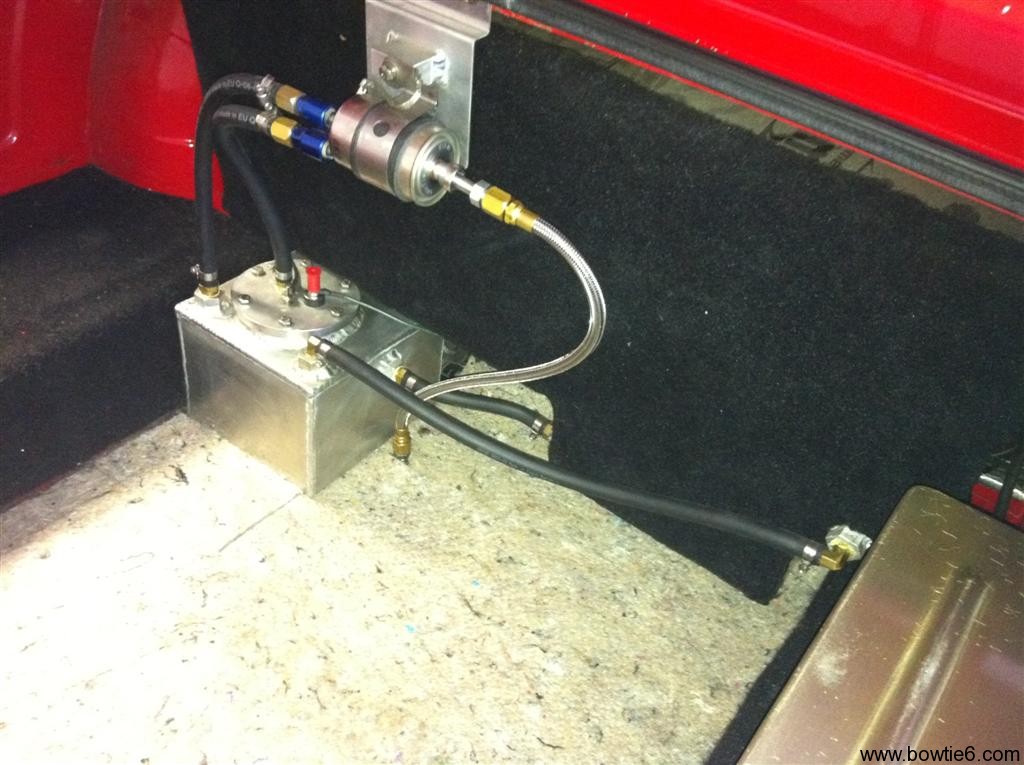
Whoa!  This looks busy.  Well, let me explain what is going on.  The fuel tank is covered with the black carpet.  At the very bottom, on the extreme right is the former “return” line input.  On the bottom of the tank you see another line feeding the small box on the left.  That is now the supply line into the small box holding the high pressure fuel pump (see picture below).  The fuel pump box above has two lines going up ending in blue fittings.  They supply high pressure fuel into the new fuel pressure regulator and combined fuel filter.  So you see, excess fuel goes back directly to the pump box.  The silver braided line coming out of the regulator feeds a stainless line that runs on the frame and feeds the fuel rail up front with high pressure fuel.  Very neat, and only one line goes forward.

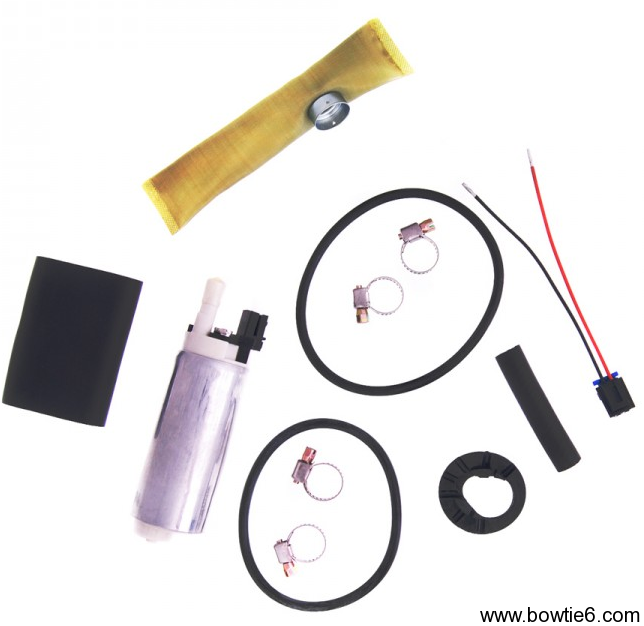
This is what the fuel pump looks like.  The pump has a “sock” that mounts to the input side.  This is a pre-filter.  The rest of the bits are the rubber isolation tube on the left and the wiring adapter.  This is all GM as fitted to Corvettes.
OK – there is a reason for all this.  If you look closely at the tank you see a protrusion at the very bottom.  Even though the tank is baffled, when doing heavy cornering fuel has a tendency to starve the pump.  We solved that by making a special lower compartment that will not allow that.  Kinda like a windage tray on an oil pan.
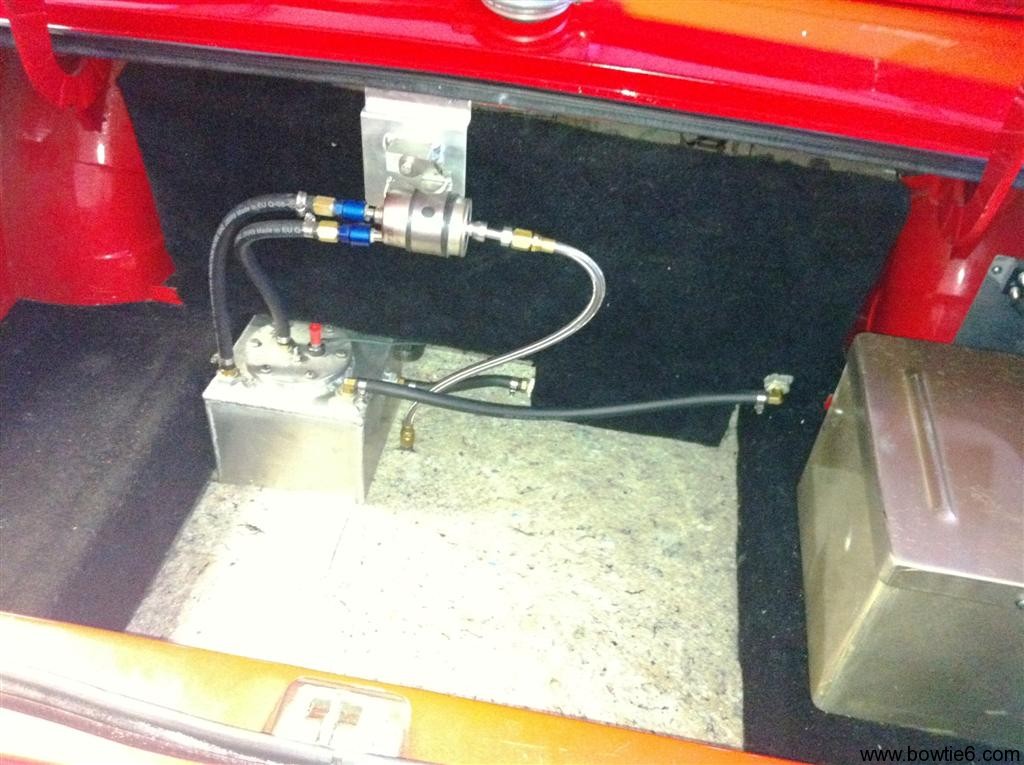
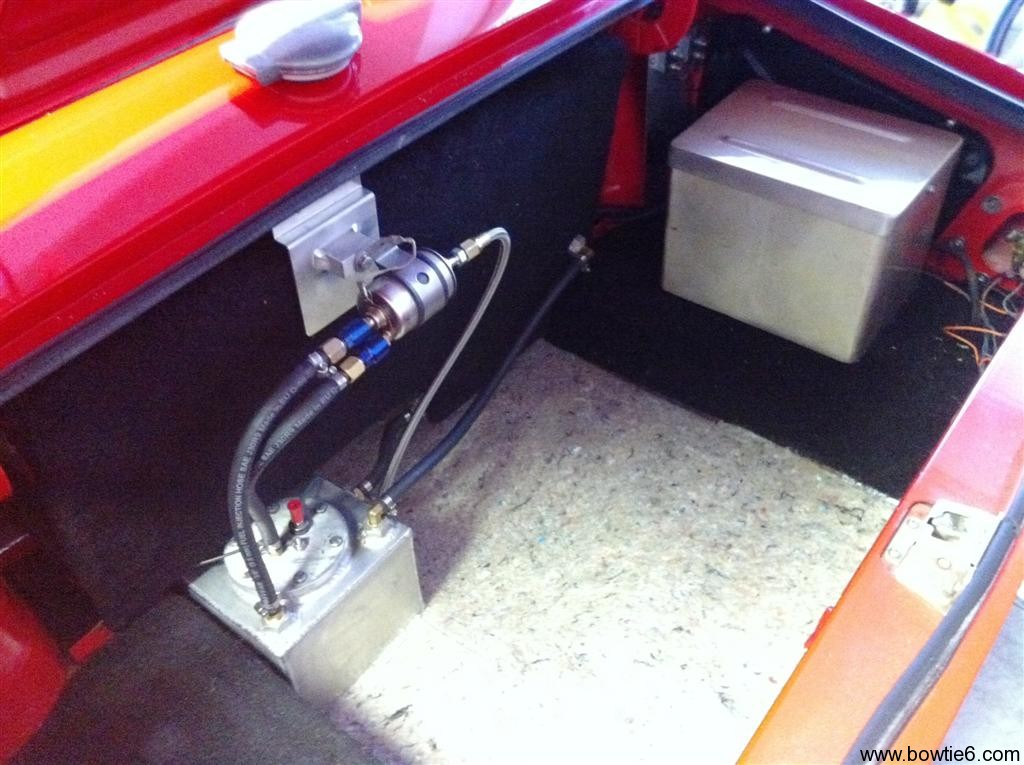
The fuel pump tank (the small box) as described previously contains a submerged GM high pressure fuel pump.  The box has a “lid” held by several screws and machined to hold Vitrol “O” rings to keep fuel from leaking.  This is a tight seal.  The rubber line at the top of the fuel pump box allows air to escape, allowing the box to always be full of fuel.

The tank holds about 15 gallons and the small box holds about another gallon (give or take).  The beauty of all this is the fuel pump box always contains fuel.  When taking turns at high speed this all now ensured no fuel starvation.

Of course all this comes at a price.  All this has taken up precious space in the trunk but then again, I don’t carry a bunch of wrenches and spare parts like many other owners of “originally” restored cars do.  Furthermore, the extra fuel capacity offers a much more respectable driving range:  I have already been able to get 350 miles of city driving from a tankfull and still had some fuel left in the tank before filling it back.  I am hoping that once I get bowtie6 on a long trip on an interstate, I can reach the 400 mile mark.  Not too bad huh?

One more picture showing the custom made aluminium battery box housing an Optima Red Top battery.  Behind the battery box is the Triumph “bleed” tank that is plumbed to the fuel tank filler neck and allows fumes to be routed back to the intake side of the engine.
 

VN:F [1.9.22_1171]
Rating: 10.0/10 (3 votes cast)
VN:F [1.9.22_1171]
Rating: 0 (from 0 votes)